
What happens inside a command center during a military strike?

Written by: Zachary B. Wolf at CNN
The controversy over who gave the order for a second strike that apparently killed people clinging to an alleged drug trafficking boat in the Caribbean has raised important questions about how and where such life-and-death decisions are made.
Secretary of Defense Pete Hegseth said Tuesday that he left the secure room where he’d been watching a live feed of the September attack and said he didn’t see survivors on digital images of the smoldering boat. “This is called the fog of war,” Hegseth told reporters.
Alongside President Donald Trump at a Cabinet meeting, Hegseth simultaneously didn’t take any direct responsibility for the second strike, but said he supports Adm. Frank “Mitch” Bradley, who oversaw the operation.
“I wish everybody could be in the room watching our professionals, our professionals like Mitch Bradley, Adm. Mitch Bradley, and others at JSOC and SOCOM,” Hegseth said.
While Hegseth could have watched the strike from a command center at the Pentagon, Bradley at the time was in command of Joint Special Operations Command (JSOC) Headquarters at Fort Bragg in North Carolina. It oversees many of the military’s special operations units, including elite Navy SEALs and the Army’s Delta Force.
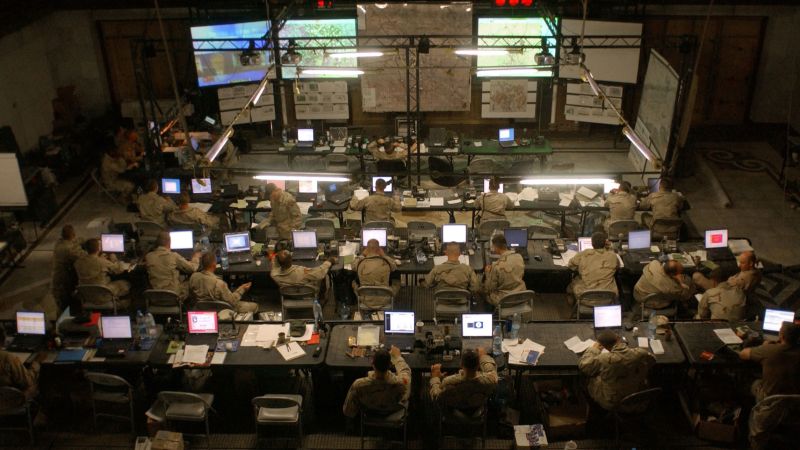
Those in the room with Bradley could have seen a bank of screens with real-time video and been able to communicate in real time both with commanders on the ground and civilian leaders like Hegseth back in Washington.
“The idea is to have everything and everybody you need right there so that you have this unblinking eye of surveillance,” retired Gen. Joe Votel said in a phone interview. “You’re confident in communication systems, up, down, left and right, and you have all the expertise that you need right around you to answer questions and get information in a very time-relevant manner,” he said.
Votel, who retired in 2019, commanded both US Special Operations Command, SOCOM, which includes JSOC, and Central Command, CENTCOM, which oversaw the wars in Iraq and Afghanistan.
Bradley has since been promoted to run SOCOM, which is based in Florida, and could also have been involved in overseeing the Caribbean strike along with SOUTHCOM, or Southern Command, which oversees the military operations in the Southern Hemisphere.
Many people up the chain of command in a secure location could presumably have logged in to watch the strike like Hegseth, who could have watched from the Pentagon.
Most Americans are probably familiar with the famous White House Situation Room photo of President Barack Obama and his team watching, in real time, the raid that killed Osama bin Laden.
This kind of operational viewing is now commonplace. Trump’s White House recently released images of Trump, wearing a signature red cap, overseeing strikes against Iran’s nuclear facilities from the Situation Room.
One of the most recent public minute-by-minute accounts of a military strike from the level of an executive branch principal comes from Hegseth himself. He inadvertently sent live details about the Trump administration’s strikes on Houthi rebels in Yemen to a group on the Signal encrypted messaging platform that included a journalist earlier this year. In that case, top Trump aide Stephen Miller and Vice President JD Vance were weighing in on the strike shortly before it happened.
As the strike occurred, Hegseth mentioned a detailed timeline for multiple strikes on targets identified by intelligence. In that case, people were the targets rather than an alleged drug boat. But the level of rigorous planning was evident. (A classified final version of the Pentagon inspector general’s report on the Signal incident found Hegseth risked compromising sensitive military information, which could have endangered American troops and mission objectives, sources told CNN.)
Immediate command over even top-level strikes like the one against bin Laden or Iran would not be handled in the Situation Room or facilities at the Pentagon, according to people familiar with the process reached by CNN.
The bin Laden raid, for instance, was overseen from a command center in Jalalabad, Afghanistan, by then-Adm. William McRaven, who was in charge of JSOC at the time. He, like Bradley, would soon go on to command Special Operations Command.
McRaven described to CNN National Security Analyst Peter Bergen the tense moments surrounding that famous raid, when he was in contact with both the on-the-ground SEALs in harm’s way and briefing the president back at the White House.
“There’s nobody who comes crashing into the office, jumping up and down, saying, oh, you gotta hit this target like tonight,” said Leon Panetta, who was CIA director during the bin Laden raid and later secretary of defense during the Obama administration.
During the war on terror there might be a pre-approved list of targets, usually people, that had already been approved by the civilian leadership. If intelligence on their whereabouts presented itself quickly, military leaders would still try to go back to the civilian leadership for approval. Operations in the war on terror are still undertaken under the legal authority granted by Congress with the authorization for the use of military force passed in the days after 9/11.
Contingencies would be discussed and debated. It was Obama, Panetta said, who insisted that extra helicopters be sent into Pakistan for the bin Laden raid. They were sent as a contingency, but needed when a helicopter crashed during the mission.
“You don’t want to have people just operating by the seat of their pants,” Panetta said. “You want to make sure you’ve considered every possible contingency that could happen.”
The attention to detail and planning makes it hard to believe the idea of anyone surviving an alleged drug strike had not been entertained. Survivors of a subsequent drug boat strike were rescued from the sea and repatriated to their countries.
The people in the room running an operation are surrounded by video feeds of targets, in contact with people on the ground and can instantly consult lawyers and aides.
“This is not an ad hoc operation,” said retired Maj. Gen. Steven Lepper, who spent a career as an Air Force lawyer and was frequently in command centers, including at al Udeid Air Base in Qatar, which was a command hub for US Central Command during campaigns in Iraq and Afghanistan.
“This is usually choreographed to correspond with the objectives of the plan and the rules of engagement, the rules under which the forces can be used,” he said in a phone interview. Lepper has said he believes the second strike on the alleged drug boat was likely a violation of the laws of war. Hegseth has talked about freeing the US military from “stupid rules of engagement.”
The commander has such an array of tools that the command center has evolved to play an integral role in operations.
“We were ultimately looking at the operation center as its own weapon system because of its capabilities to control other weapon systems,” Lepper said.
“People are locked in,” Votel said. “Everybody knows what their responsibilities are. This is something we rehearse. It’s a well orchestrated process.”
There’s a professional need to keep things focused and avoid chaos. “You want to promote an atmosphere where, if I have to talk somebody, I can do it,” he said.
Another former official with experience in command centers who spoke on background said it is standard practice for the military to assess damage and perhaps strike again at a boat that was not sunk, but officials will call it a “re-attack” rather than use the “double-tap” language that has become associated with the strike on the alleged drug boat.
Authority to re-attack would likely have been worked out in advance of the strike to the officer with “target engagement authority,” which Hegseth apparently delegated to Bradley. The Washington Post reported Hegseth gave a “spoken directive” to kill everyone aboard the vessel, something Hegseth has denied.
Traditionally, JSOC would have regional command centers that might also be involved in a strike and where authority could further be delegated, although it’s not clear if that was the case in the Caribbean.
Yes! - Another key feature of modern military strikes is an after-action review, something that will be important as the legality of these strikes — and the nature of the orders that led to them — are scrutinized.